
Balance bikes & tricycles


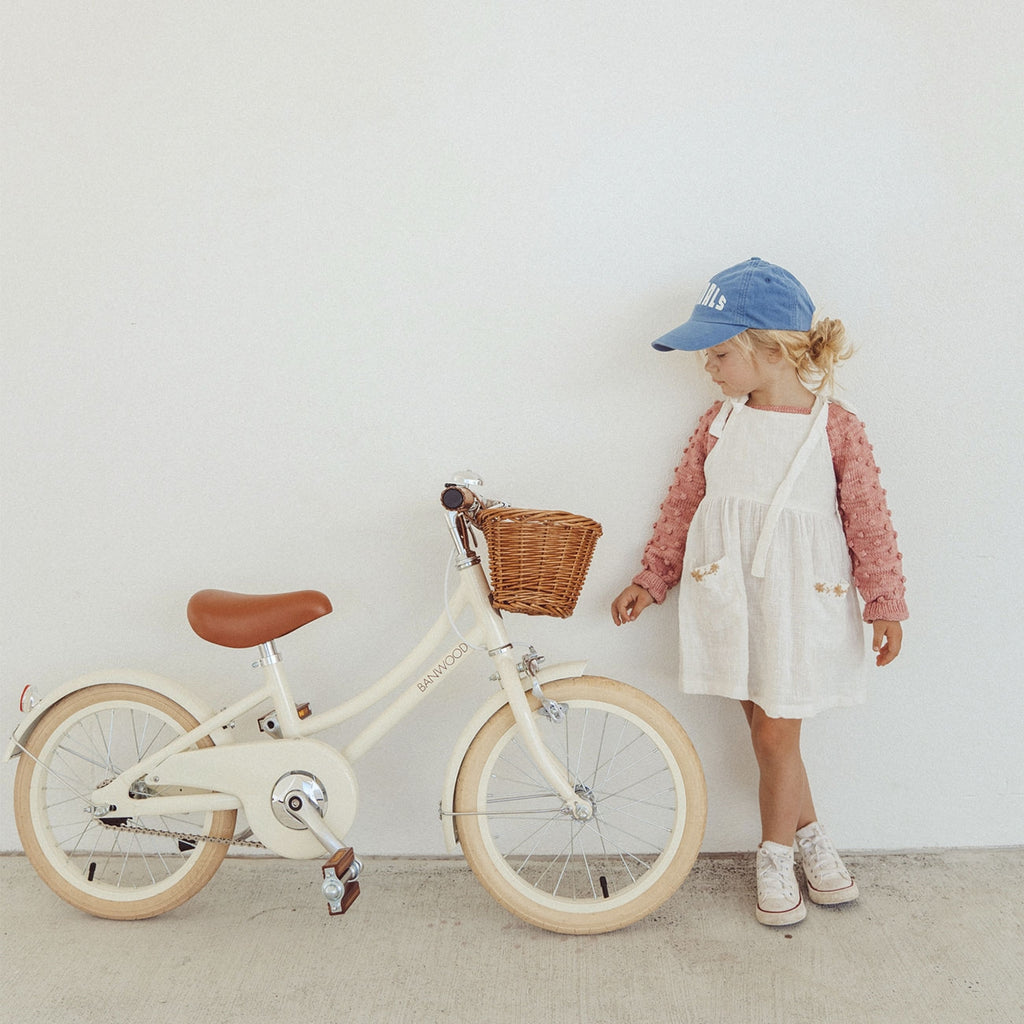


Are balance bikes really useful for children?
Yes. On a balance bike, your child learns to balance and push off. These two things are often the biggest hurdle when learning a bicycle. Children who have ridden a balance bike usually transition directly to a bicycle without training wheels. It also improves coordination, leg muscles, and a sense of speed and braking distance.
From what age is a balance bike with two wheels suitable?
Most children start riding a balance bike between the ages of 2 and 3. The crucial factor isn't age, but whether your child can walk confidently and get on and off independently. Younger than 2? Then a tricycle or a ride-on toy is a better starting point, as it can stand upright on its own.
Which balance bike fits which size?
The crucial factor is stride length, not height. Measure from the ground to the crotch and subtract 1 to 2 cm: this is the maximum saddle height. Your child must be able to sit with both feet flat on the ground. As a rule of thumb: 12 inches for the youngest children, 14 inches for children around 100 cm tall and above.
Balance bike or tricycle — which is the better way to start?
A tricycle doesn't tip over and gives very young children a sense of security, often from as young as 18 months. However, it doesn't do much to develop their balance. A balance bike is more challenging and prepares children directly for riding a bicycle. Many families use both, one after the other: first a tricycle, then a balance bike from around 2,5 years old. Suitable outdoor toys complement both well.
Wood or metal — which material is better?
Wooden balance bikes are lightweight, look nice, and don't require paint that can scratch off. However, they don't hold up well to prolonged rain. Metal frames are more durable, offer finer height adjustments, and therefore last longer as the child grows. For outdoor use in all weather conditions, metal is the more robust choice, while wood is sufficient for indoor use and the garden.
Does my child need a helmet when riding a balance bike?
Yes, from the very first ride. A bicycle helmet should sit horizontally, end two finger-widths above the eyebrows, and not slip when you shake your head. Never buy one that's too big. If you wear a helmet from the start, you won't argue about it later when cycling. Closed shoes also protect your toes when braking.
Does a balance bike need a brake?
Not at first. Small children brake with their feet, and they're faster than any handbrake. A handbrake becomes relevant around 3,5 to 4 years old, when your child is riding fast and going downhill. Make sure the brake lever is small enough for a child's hand and easy to pull.
Pneumatic tires or solid rubber tires — which should I choose?
Pneumatic tires cushion roots and cobblestones and roll more quietly. However, they can get punctures and need occasional inflation. Solid rubber or EVA tires are maintenance-free and ideal if your child mainly rides on asphalt and indoors. Pneumatic tires are clearly recommended for forest paths and gravel areas.
How do I adjust the wheel correctly?
Have your child sit on the saddle: Both feet should be flat on the ground, and their knees slightly bent. The handlebars should be roughly at navel height to ensure a straight back. Check the height every few months, as children grow quickly. While you're at it, tighten all the screws.
How fast is the balance bike at my home?
LanaLu is a Swiss online shop with a warehouse in Switzerland. What you order today will usually arrive tomorrow—no customs paperwork and no waiting from abroad. Perfect if you want that balance bike to be under the covers in time for your child's birthday. Find more gift ideas under Gifts.
 Deutsch
 Deutsch
 English
 Français
 Italiano
 Español
 Hrvatski
 Türkçe
 Shqip
 Bosanski
 Română
 Українська